DISCLAIMER: This is not financial advice, and you should not consider it to be. The content is for informational and educational purposes only.
NOTE: Unlike my previous investment memo, this analysis does not provide a comprehensive history or overview of the company. I recommend reviewing CreditSights or another investment memo on the company before reading this analysis.
The memo was written on May 4, 2026.
CREDIT INVESTMENT AND THESIS:
Bausch Health Companies presents a compelling mispriced distressed credit opportunity driven by a fundamental disconnect between market-implied outcomes and underlying asset value.
Consensus is anchored to an overly simplistic “patent cliff” narrative around Xifaxan, extrapolating a rapid revenue collapse and near-zero free cash flow post-2028, ultimately implying forced asset sales and impaired creditor recoveries.
We believe this view materially mischaracterizes both the timing and severity of erosion, while underappreciating
the durability of the HE franchise,
the staggered nature of generic entry,
and the embedded optionality within BHC’s asset base (most notably BLCO and Solta.)
As a result, the market is systematically undervaluing forward cash flow generation and recovery value across the capital structure, creating an attractive asymmetric opportunity, particularly in the 2L and near-dated unsecured bonds, where we see equity-like returns with materially lower default risk.
PRO-FORMA CAPITAL STRUCTURE:
PRO-FORMA MODEL:
INDUSTRY OVERVIEW:
The U.S. specialty pharmaceutical industry is operating in an increasingly challenging policy and competitive landscape. Branded drug manufacturers face a convergence of pricing pressure, loss-of-exclusivity (LOE) risk, and evolving demand dynamics —headwinds that are particularly acute for companies with concentrated portfolios and limited pipeline depth.
The Inflation Reduction Act
The Inflation Reduction Act has introduced a structural shift through Medicare’s Drug Price Negotiation Program, enabling CMS to select high-expenditure small-molecule drugs for price negotiation as early as seven years post-approval (vs 11 years for biologics). This compressed exclusivity window materially alters the risk-adjusted return profile for small-molecule assets and is already driving capital reallocation toward biologics and other complex therapies. (Simply, the capital is moving from small-molecule assets to biologics)
Xifaxan (majority of BHC’s cash flow) has been selected for CMS’s second round of negotiations, with negotiated pricing set to take effect on January 1, 2027—preceding expected generic entry in 2028. This sequencing creates a dual-phase revenue compression event concentrated in Bausch Health’s highest-margin product.
However, this is not BHC’s sole problem. Most branded pharmaceutical companies with key assets approaching LOE between 2026 and 2029 face similar layered risks, including patent expirations, litigation-driven early generic entry, and authorized generic launches. While authorized generics may partially cushion volume erosion, they typically accelerate net revenue decline and margin compression.
The gastrointestinal therapeutics market is becoming more competitive across both branded and generic channels targeting IBS-D and HE, while payors and pharmacy benefit managers are putting price pressure that can accelerate share loss. In contrast, the eye health segment—where Bausch Health participates through its majority stake in Bausch + Lomb—benefits from more durable secular tailwinds, including aging demographics and increased contact lens penetration. However, this segment remains highly competitive across surgical, pharmaceutical, and consumer health categories, limiting margin expansion potential.
COMPANY OVERVIEW:
Bausch Health Companies Inc (NYSE/TSX: BHC), a Canada-incorporated specialty pharmaceutical and medical device company headquartered in Laval, Québec, operates a diversified platform across four segments:
Salix (gastrointestinal),
Bausch + Lomb (eye health),
International, and
Diversified.
The Company generated approximately $10.3 billion in consolidated revenue, with Bausch + Lomb contributing $5.1 billion, while Salix remains the primary EBITDA driver, (with its flagship product, Xifaxan).
Xifaxan generated approximately $2.2 billion in 2025 revenue (with almost 70% EBITDA margin) and is approved for two core indications:
irritable bowel syndrome with diarrhea (IBS-D) and
overt hepatic encephalopathy (OHE or HE)
making Xifaxan the Company’s most critical asset from a credit perspective.
Bausch Health maintains an approximate 88% economic interest in Bausch + Lomb Corporation (NYSE: BLCO), which completed its IPO in May 2022. However, the planned full separation of Bausch + Lomb remains incomplete, contingent on leverage reduction targets, regulatory approvals, and the resolution of ongoing Xifaxan-related litigation—factors that continue to complicate the Company’s capital structure.
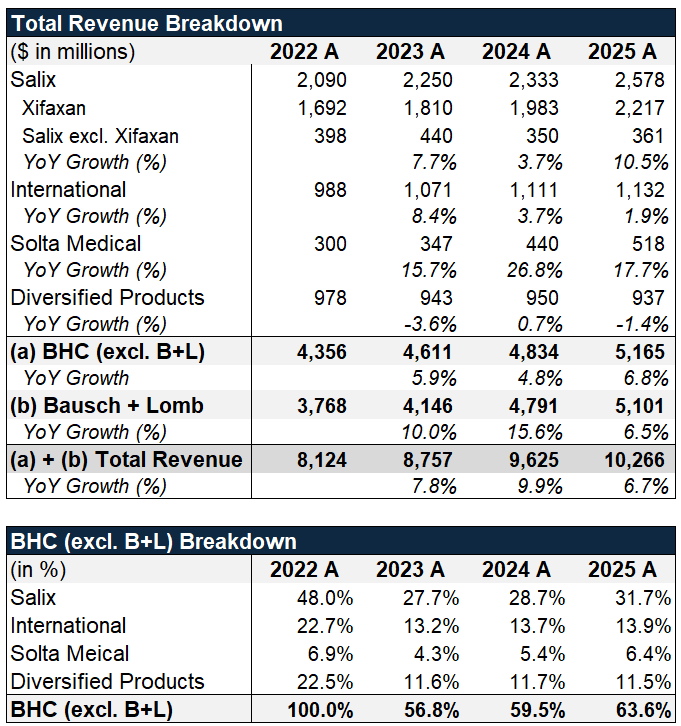
For full-year 2025, consolidated adjusted EBITDA attributable to Bausch Health was approximately $3.5 billion, reflecting continued revenue momentum. However, free cash flow declined year-over-year, primarily due to increased working capital requirements and higher interest expense.
Formerly known as Valeant Pharmaceuticals, the Company continues to carry the legacy of its prior acquisition-driven roll-up strategy, which resulted in one of the most highly levered balance sheets in the specialty pharmaceutical sector—a structural overhang that remains central to the credit story.
MANAGEMENT OVERVIEW:
Bausch Health is led by Thomas J. Appio, who assumed the role of CEO in May 2022 which coincided with the Bausch+Lomb IPO and the separation of BHC’s standalone leadership structure. Appio brings over three decades of pharmaceutical industry experience, including 23 years at Schering-Plough across diverse international markets, followed by leadership roles within Bausch + Lomb, including President and Co-Head of B+L International from 2018 through 2021.
His operational background is weighted toward international commercial execution and ophthalmology rather than capital markets or financial restructuring, a profile that has drawn scrutiny from creditors given the complexity of BHC’s balance sheet management challenges.
It seems that CFO is keep changing, which could be a potential red flag.
The average tenure of the broader management team stands at approximately 3.3 years, indicative of the significant organizational disruption that accompanied the post-Valeant restructuring and the B+L spin-off process.
Management’s credibility with credit investors will ultimately hinge on its ability to execute a viable liability management strategy ahead of the Xifaxan LOE cliff, a task that demands both financial engineering and operational discipline that the current leadership team has yet to be fully tested.
MARKET CONSENSUS AND MISPRICING:
Our investment thesis is anchored in the view that the market misinterprets Bausch Health Companies across several key areas:
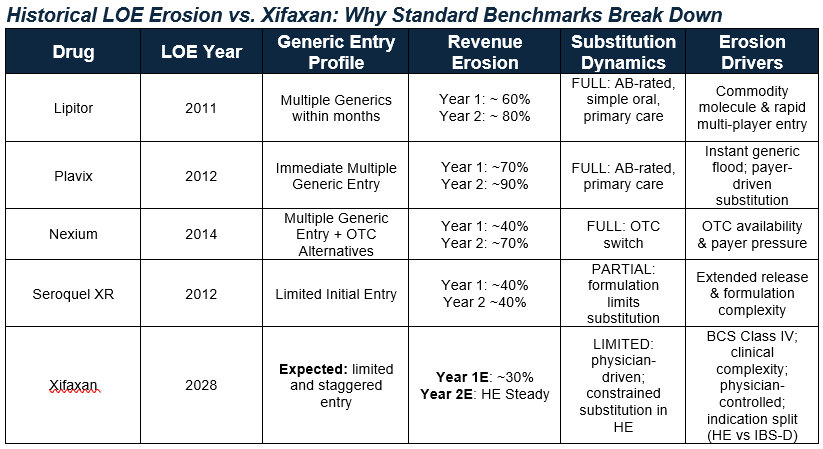
The market assumes a single-event revenue cliff following Xifaxan’s loss of exclusivity (LOE) in January 2028, with immediate and simultaneous generic entry driving a +50% decline in Year 1 and an additional +30% decline in Year 2
As a result, consensus expects post-LOE free cash flow to collapse to near zero
This perceived cash flow deterioration implies that BHC would be forced into a distressed or fire-sale divestiture of BLCO
The market assigns overly low valuation multiples to the International, Solta, and Diversified segments, reflecting an overly punitive view of their earnings quality
Our analysis challenges the market’s core assumptions around Xifaxan’s LOE trajectory, the likelihood, timing, and valuation of a BLCO sale, and the valuation of BHC’s underlying segments.
We view the widely assumed revenue cliff and post-LOE free cash flow collapse as second-order consequences of these misinterpretations and not primary drivers of value.
We believe the market undervalues Bausch Health Companies and Xifaxan due to three core misunderstandings:
Xifaxan is a one-of-a-kind drug and exhibits unusually high switching costs
It targets two distinct diseases with durable, diversified revenue streams, with HE exclusivity extending through October 2029.
Bausch retains high-quality, growing segments, particularly Solta, that offer both monetization optionality and durable cash flow generation.
1. Xifaxan LOE Will Not Follow a Standard Generic Erosion Curve
We believe Xifaxan is pharmacologically and commercially different from comparable drugs, resulting in less severe revenue erosion post-LOE.
Xifaxan (rifaximin) is a BCS Class IV drug (low solubility, low permeability), requiring additional human clinical testing beyond standard bioequivalence trials, thus increasing the complexity, cost, and timeline of generic entry.
This dynamic is already observable in the European market. Despite Xifaxan’s exclusivity expiring in mid-2025, there has been no meaningful generic entry. This provides a highly relevant real-world data point: a market with no patent protection, a regulatory framework supportive of generics, and clear commercial incentives, yet still no meaningful generic penetration. The absence of entry reflects the clinical and regulatory complexity of establishing bioequivalence for this molecule. If the European experience is indicative, and it is the only directly comparable post-exclusivity market, Xifaxan’s generic erosion is likely to be slower and less severe than a standard LOE trajectory.
However, in the US, the FDA has accepted bioequivalence study designs from Teva, Sandoz, Sun, and Amneal, positioning these players for potential generic entry. Crucially, these designs didn’t incorporate traditional in vivo (human) studies, calling into question the clinical robustness of equivalence and the ultimate effectiveness of generic substitution.
Switching costs for Xifaxan, particularly in hepatic encephalopathy (HE), are structurally high. The prescribing decision is physician-driven, not patient-driven, and therefore less sensitive to price than typical generic substitution. Physicians are primarily incentivized to minimize clinical and malpractice risk, especially for chronic, high-risk conditions like HE.
As a result, the threshold to switch to a generic is meaningfully higher. This is further reinforced by uncertainty around the clinical robustness of generic equivalents, which reduces physician willingness to substitute away from Xifaxan.
That said, we do expect more meaningful erosion in the IBS-D indication, which accounts for approximately 60% of Xifaxan revenue and is more exposed to conventional generic substitution dynamics.
In fact, there are multiple drugs that treat IBS-D and HE. However, they are less effective than Xifaxan, thus Xifaxan is preferred. For the reasons mentioned, we believe generic substitution will be less effective than the market expects, resulting in less severe revenue erosion.
2. Xifaxan’s Overlooked Indication Split Extended 2029 HE Protection
Xifaxan is often modeled as a single product facing a single LOE event in 2028. That framing is fundamentally incorrect. While Xifaxan is one drug, it treats two different diseases, and it represents two distinct revenue streams: IBS-D and hepatic encephalopathy (HE):
IBS-D (Irritable Bowel Syndrome with Diarrhea)
Treats Travelers Diarrhea
Represents approximately 55–60% of Xifaxan sales
Short-course treatment (typically ~2 weeks)
Primarily outpatient, commercially insured
This is the portion exposed to generic competition starting in 2028
HE (Hepatic Encephalopathy)
Manages the symptoms of hepatic encephalopathy (HE).
Represents approximately 40–45% of Xifaxan sales
Chronic, lifelong therapy (taken daily, indefinitely)
Diagnosed and managed by hepatologists
500,000 Americans have HE and 20,000 to 40,000 get hospitalized annually
Globally, approximately 60 million people are diagnosed with cirrhosis
HE portion is protected until October 2029
The Federal Circuit confirmed in April 2024 that BHC’s HE patents are valid and infringed, and a district court ruling in 2025 prevents the FDA from approving any HE-labeled generics before October 2029. This means meaningful generic competition in HE generics is legally blocked until 2029.
There is also no easy workaround for competitors: current generic approvals, such as Amneal’s, apply only to IBS-D, and expanding into HE would require additional clinical trials and a supplemental regulatory process, which is both time-consuming and uncertain. As a result, generics entering in 2028 cannot directly compete for HE prescriptions.
As mentioned earlier, from a clinical view, substitution is also inherently difficult. Because no HE-labeled generic exists, pharmacists cannot automatically substitute a generic. Any change in treatment requires an active decision by the physician. This is particularly important given the nature of the patient’s condition: HE patients are typically very sick, often with advanced liver disease, and require continuous, long-term therapy.
Key Point: Although IBS-D accounts for most sales, the HE segment is far more valuable from a credit perspective. These patients depend on Xifaxan daily and indefinitely, making this 40–45% of revenue highly recurring, resistant to switching, and protected until 2029.
These dynamics have a clear economic implication for Bausch Health Companies: Xifaxan revenue is likely to be more durable and decline more gradually than the market expects. The HE segment, which accounts for approximately 40–45% of total revenue, remains protected through 2029, ensuring that a meaningful portion of sales persists even after initial generic entry in 2028. Meanwhile, high clinical switching costs and limited automatic substitution slow erosion within the IBS-D segment.
As a result, rather than a sharp revenue cliff, BHC is more likely to experience a staged and gradual decline, preserving a significant portion of its cash flow. Given that Xifaxan is one of the company’s largest and highest-margin products, this durability supports earnings and operating cash flow through the 2026–2028 period, providing BHC with greater flexibility to manage its capital structure and pursue strategic actions.
Importantly, generic competition is also likely to be phased rather than immediate. Under the Hatch-Waxman framework, initial entry is expected to be limited, with a single generic entrant in early 2028, followed by broader competition beginning in the second half of the year. This staggered entry further controls near-term erosion.
Finally, the market’s implied revenue decline appears inconsistent. Xifaxan revenue is split between IBS-D, which loses exclusivity in 2028, and HE, which remains protected until October 2029. For total revenue to decline by ~44–50% in 2028, the IBS-D segment alone would need to fall by approximately 57–60% within a single year, an outcome that appears unlikely given the combination of limited initial competition, clinical complexity, and physician-driven prescribing dynamics.
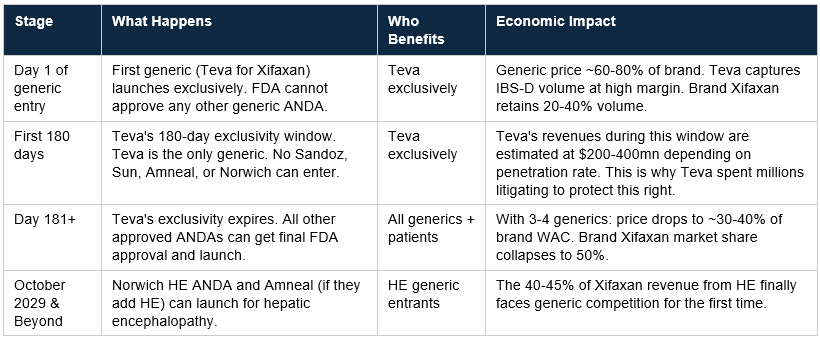
In the first half of 2028, there is only one generic competitor. In this situation, generics are usually priced at about 65–70% of the brand, and the original drug can still keep around 25–40% of its volume. This suggests a more moderate decline of about 20–30% in IBS-D, not a sharp collapse.
Bigger price drops usually happen only when multiple generics enter, which would only happen in the second half of 2028. So most of the pressure comes later, not immediately.
Also, the HE part of the business is fully protected until late 2029, so a large part of the revenue is not affected at all in 2028.
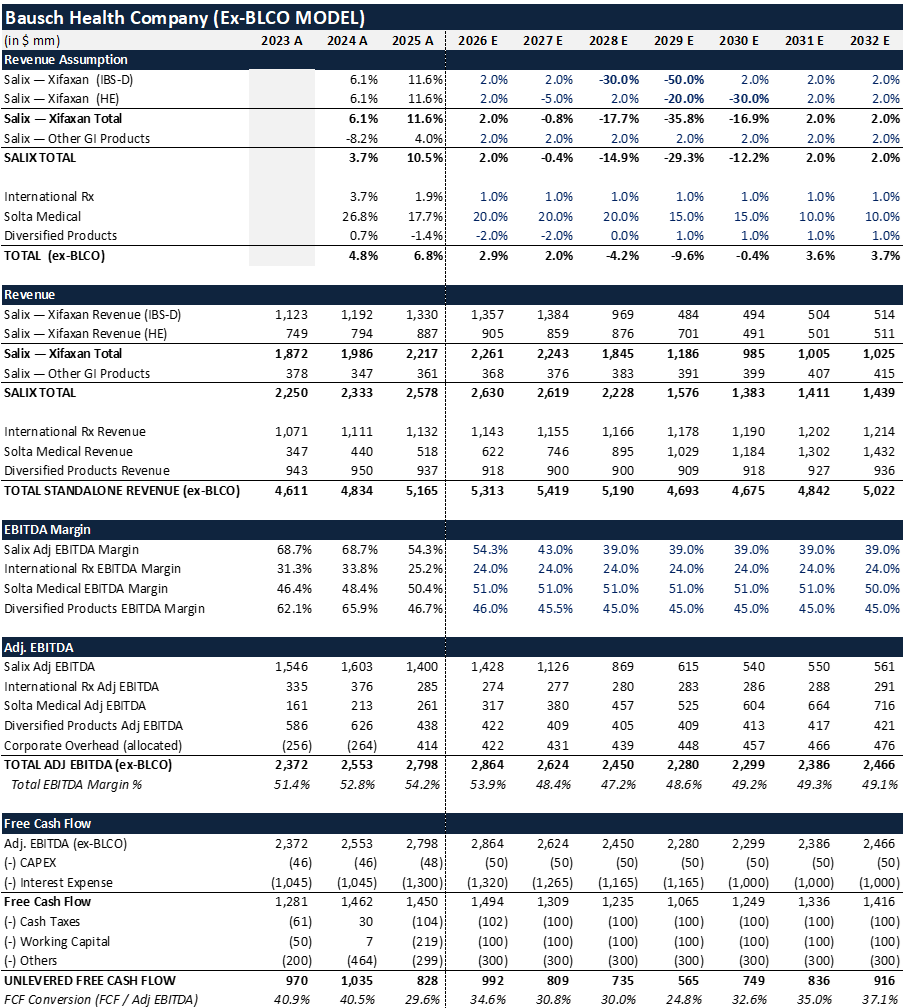
Putting this together, revenue decline should be gradual, not sudden. A more realistic estimate for 2028 revenue is around $1.2–1.38 billion, which is higher than what is being assumed. This adds about $30–138 million in extra cash flow for the year.
Combined with stronger performance in earlier years, this gives the company more financial flexibility, lowers risk, and gives more time before needing to make big decisions like selling assets. There is a risk that Amneal Pharmaceuticals could enter earlier due to litigation, but this would only affect IBS-D and not HE. (And we agree with the market that Amneal Lawsuit will not result in LOE in 2027)
3. BLCO is Undervalued and Current Stock Price Isn’t the Best Measure
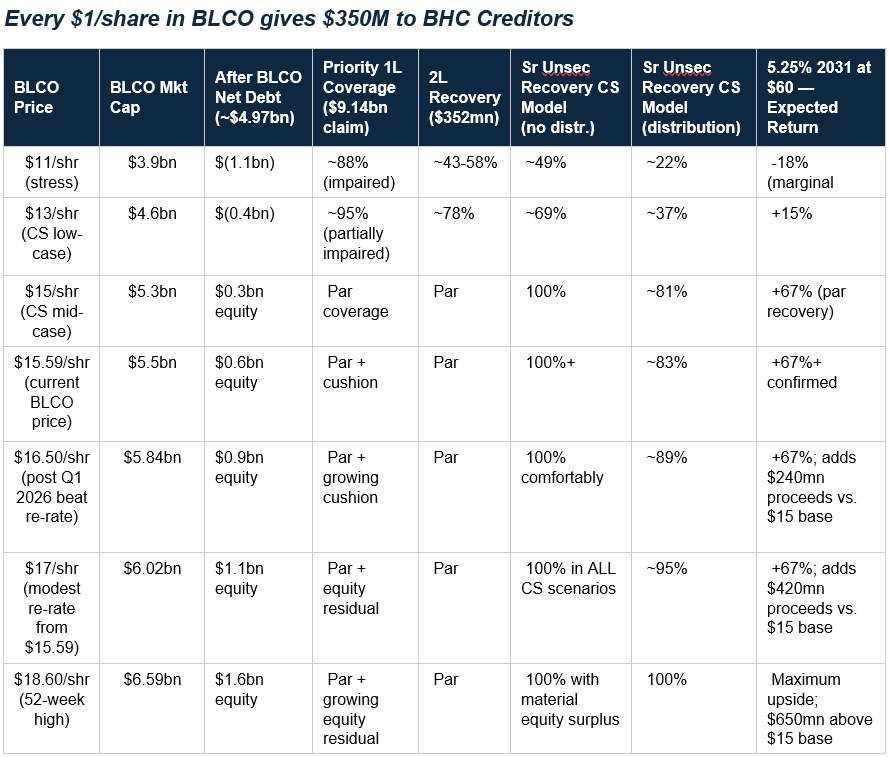
We believe BLCO is significantly undervalued, and it understates recovery of the bonds. BLCO is one of the most important assets in BHC’s capital structure because BHC owns approximately 88.7% of BLCO. This means that BLCO’s equity value directly affects how much value is available to BHC creditors. The market is still using a conservative BLCO valuation, but recent Q1 2026 results show that BLCO is growing, improving margins, and raising guidance. Because the bond market has not fully incorporated this improvement, BHC’s bonds remain mispriced.
1. BLCO’s Q1 2026 results were stronger than expected. BLCO’s recent results support a higher valuation because the company is growing revenue, improving profitability, and performing better than consensus expected. In Q1 2026, BLCO reported $1.244 billion of revenue, up 9% year over year. This was also above market expectations of roughly $1.22 billion.
a. Proof Reason 1: Growth was broad-based across BLCO’s business segments. Vision Care revenue increased 8%, Surgical increased 7%, and Pharmaceuticals increased 14%. Important products also grew strongly: MIEBO grew 33%, XIIDRA grew 30%, LUMIFY grew 15%, and contact lenses grew 23%. This shows that BLCO’s growth is not dependent on one isolated product; it is coming from multiple parts of the business.
2. BLCO’s margin improvement is structural, not temporary. BLCO is not only growing revenue; it is also becoming more profitable. This matters because a higher-margin business deserves a higher valuation multiple. In Q1 2026, BLCO reported adjusted EBITDA (excluding acquired IPR&D) of $200 million, up from $126 million in Q1 2025. That represents 59% yoy growth. Its adjusted EBITDA margin expanded to 16.1%, up from 11.1% the prior year, a 500 basis point improvement.
3. Reason 3: BLCO raised guidance, confirming management confidence. BLCO’s Q1 results were strong enough that management raised full-year 2026 guidance less than 75 days after issuing the original guidance. BLCO increased its FY2026 revenue guidance from $5.375–$5.475 billion to $5.420–$5.520 billion, raising the midpoint by approximately $45 million. It also raised adjusted EBITDA excluding acquired IPR&D guidance from $1.000–$1.050 billion to $1.010–$1.060 billion, raising the midpoint by approximately $10 million.
Key Point: BLCO is mispriced because the market continues to apply conservative assumptions despite clear evidence of improving fundamentals. The company is now delivering stronger revenue growth, meaningful margin expansion, and has already raised guidance. This discount was previously justified by concerns around weak growth and margins, but recent results directly contradict those concerns. At the same time, the bond market has not fully reflected this improvement because distressed credit reprices more slowly than equity. Many bondholders are constrained by mandates, ratings limits, or liquidity needs, which delays price adjustment even when underlying asset value improves. As a result, BLCO’s equity value can increase while BHC’s bonds remain priced using outdated assumptions, creating a disconnect between true asset value and current bond pricing.
4. Solta is the Crown Jewel
One of the most persistent market views is that BHC will be forced to sell BLCO, and the remaining business is evaluated at a deeply discounted multiple that reflects an overleveraged, declining company with little to no growth.
This market view ignores that BHC operates three additional segments that collectively generate approximately $2.59 billion of revenue and approximately $986 million of EBITDA at current margins and are entirely independent of Xifaxan’s patent status.
We believe Solta Medical is the most important of these segments from a valuation perspective. We have observed strong demand growth for Fraxel and Thermage across Asia, particularly in South Korea and China. (We personally have tried it as well)
Solta generated $518 million of FY2025 revenue at approximately 50% EBITDA margins, with revenue growth of more than 20% in recent years. Solta is rapidly growing in South Korea and China.
For example, the company acquired Shibo Zhenmei (in December 2025) distribution business in China for $87 million to expand its business in China. There is a significant on-going “beauty boom” in South Korea and China where Solta can capture EBITDA growth and multiple expansion.
Also, the company tried to IPO Solta before. In 2022, BHC withdrew its Solta IPO filing because of the weak IPO market, but the underlying business has continued to grow rapidly. The business is currently valued at approximately 8.0–8.5x EV/EBITDA.
The global energy-based aesthetic device market is projected to grow at 13 to 14 percent compound annual growth rate through 2033 according to Astute Analytica’s October 2025 industry report, providing a durable secular tailwind that is entirely decoupled from Xifaxan’s commercial trajectory.
At a 20% CAGR sustained through 2029 (below Solta’s recent run rate) Solta reaches approximately $1.1 billion of revenue and approximately $550 million of EBITDA, worth approximately $4.5 billion at a 8x multiple, or nearly double the current BLCO-adjusted BHC equity market cap. Also, many cosmetic companies that have South Korea and China exposure have been trading at almost 20x. If we give a relatively conservative multiple to Solta of 15x - 20x, that is $8.5bn to $10bn, enough to service most debt.

The argument for 15–20x: The market values Solta at a 8.5x EV/EBITDA, consistent with broad US med-device comps. But Solta is not a broad med-device company, it is a high-growth aesthetic energy-based device business with 50%+ EBITDA margins, 20%+ revenue growth, global brand recognition (Thermage, Fraxel), and expanding recurring consumables revenue.
The comparable companies, Classys (35% revenue growth, 48-52% EBITDA margin, 18-22x EV/EBITDA) and Hugel (14-15% growth, 45-47% EBITDA margin, 16-18x EV/EBITDA), both trade at 16-22x.
The correct comparable universe is the Korean high-growth aesthetic peer group, not legacy US device makers. At 17x FY2025 EBITDA ($262mn), Solta is worth ~$4.5bn of enterprise value, more than double the market’s estimate, and represents the largest single source of upside optionality in the BHC sum-of-parts beyond the BLCO sale itself.
It is also very important to note that the majority of Solta’s growth comes from Korea and China, and potential buyers are likely to be from the region who is more willing to give 10x+ valuation.
RISK AND RETURN ANALYSIS:
Based on our contrarian view, we recommend the following:
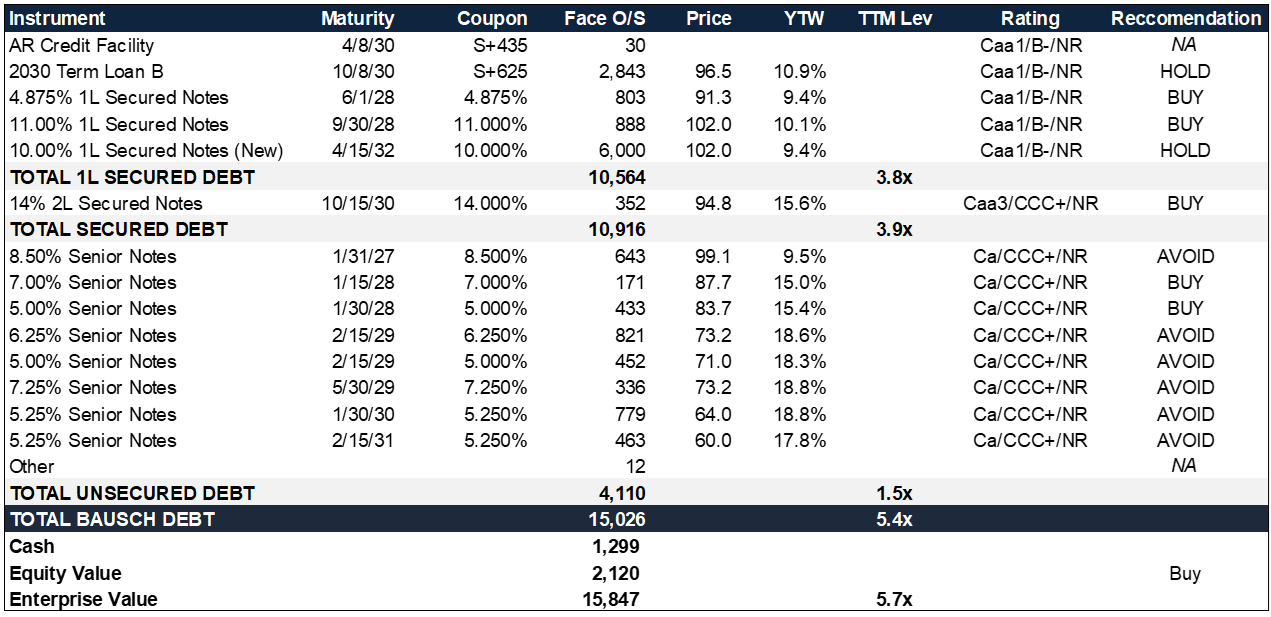
Priority 1L ($10.8bn): AVOID the 10% Notes and TLB, and Buy Legacy 1L
HOLD: 10% Priority 1L Notes 2032 ($102, 9.4% YTW)
We believe most are already “priced-in”; the bond has “double-dip” but because we expect par recovery, it is not relevant.
upside capped at 3-5pts (105% call vs $102); downside 15-20pts if BLCO sale slips to 2028 or BLCO trades below $12.
At $102 you earn 9.4% YTW to take BLCO timing risk (which is not sufficient, especially as BLCO and Solta becomes more critical after LOE, 2028~. Even though maturity is in 2032, the additional return does not suffice additional risk for 4y+)
It is most likely that the bond will be paid in full, but we believe the return (at the current rate) is NOT lucrative compared to others
HOLD: 2030 Term Loan B ($96.5, 10.9% YTW)
TLB is strictly better risk/return than the 10% notes (same trigger, 150bps more carry, $3.5pts price upside to par, floating rate, but matures two years earlier, meaning less risk).
However, similarly, we believe there are better risk/return in different capital structure. Marginally better than other 1L but still Poor risk/return
BUY: Legacy 1L 2028s (4.875% at $91.5, 11% at $102)
Given their our analysis is much more optimistic than the market (even more optimistic than Credit Sight’s view), we believe it is less likely that the bond will be default before maturity.
The bond at the current price offers YTW of 9~10%, which is almost equity return. Given that we believe it is extremely less likely that the bond will default, we believe this is a great opportunity to have equity-like return for BB like default probabilities (especially given that we believe LOE will happen post 2028 with lesser revenue erosion)
However, we believe other capital structure offers more attractive risk and return profile.
2L Secured Notes ($352mn, $95, 15.6% YTW): Strong Buy with Good Risk/Return
BUY: 14% 2L Notes ($94.8, 15.6% YTW)
We believe 2L is essentially a high-yield bond treated (by the market) as distressed credit. We expect 14% coupon, with near-certain par recovery, and the only real risk is BLCO fire sale and Solta’s underperformance, which we believe is less likely.
However, the unsecured are the better absolute return trade if you have conviction on the thesis. But the 2L makes sense as a lower-volatility complement, particularly for a position where you want credit exposure to BHC without taking additional risk.
Senior Unsecured Notes: Weaker Marginal Yield / Risk
HOLD (DON’T BUY): 8.5% Sr Unsec 2027 ($99.1, 9.5%)
Although we expect full recovery and 9.5% YTW is attractive, it is not as attractive as Legacy 1L 2028 or 2L.
We also believe this will expose us to reinvestment risk and high opportunity cost of missing investment in other capital structures.
BUY: 5.0%, 7.0% Sr Unsec 2028 ($87.7, $83.7, 15.0%, 15.4%)
The bond offers more than sufficient return given that they mature in January of 2028, only a single competitor starts generic
We are highly optimistic that the bond will be paid in par
AVOID: 5.0%, 6.25%, 7.25% Sr Unsec 2029 (18.3-18.8%)
Although the bond has highly attractive return, we believe 300bps point is not sufficient to take over 2028 Sr Unsec.
If our analysis on LOE, Solta, and BLCO is wrong, this will more than likely be impaired. 300bps is not sufficient to take additional risk for another year when LOE and related revenue erosion significantly worsens
AVOID: 5.25% 2030 + 5.0% 2030, 5.25% Sr Unsec 2031
Same reason as above. 2028 and 2L already provides lucrative return of 15%, and we believe there is NO merit in taking additional risk (of impairment) for 300bps.
We believe the Sharpe ratio for post 2029 senior unsecured is relatively lower compared to the legacy 1L, 2L, and pre-2029 senior unsecured. We still believe that there is higher chance (much higher than market’s assumption) of BHC not going bankrupt. However, that alone does not justify BUY on senior unsecured as there are more attractive investment opportunities (like 1L, 2L, possibly equity), and therefore, we recommend hold on senior unsecured.
Equity: Strong Buy with Optionality
However, while we acknowledge a non-zero probability of a restructuring scenario, we view bankruptcy risk as materially overstated by the market given BHC’s asset coverage and cash flow durability.
Our conviction is anchored in the value and monetization potential of Solta, which we believe is significantly mispriced and represents the primary source of equity upside. At ~50% EBITDA margins and sustained 20%+ growth, Solta is structurally more comparable to high-growth Asian aesthetic peers trading at 15–20x EV/EBITDA, implying a standalone valuation of $4.5–$8.5bn versus the market’s implied ~8x multiple. This alone supports a substantial portion of BHC’s enterprise value and provides a credible path to deleveraging without distressed asset sales.
In parallel, BLCO offers additional optionality, with improving fundamentals and recent guidance revisions supporting a higher equity valuation and incremental recovery for stakeholders. Importantly, both assets are monetizable and largely independent of Xifaxan’s LOE dynamics, creating multiple avenues to address the capital structure. As a result, we believe the market is overly discounting a downside scenario while failing to fully incorporate asset-level value, leaving BHC equity mispriced with asymmetric upside at current levels.